Sunday, October 5, 2008

219: The impact of Cash Transfers

Two weeks ago, I met with 70 ancient grandmothers under some trees outside the Ethiopian capital of Addis Ababa. All the grandmothers wore white cotton shawls and sat on the ground or on some cement blocks because there weren’t any chairs. I greeted each one formally with the few words of Amharic that I learned. In turn, the women proffered blessings onto the Stephen Lewis Foundation (www.stephenlewisfoundation.org) that provided for their sustenance and made my visit possible. All of these women were widows, desperately poor, who were nevertheless saddled with the care of grandchildren following the illness and death of their own children primarily due to war or HIV/AIDS.

This is not an unusual situation. Between 40 and 60% of all orphans in sub-Saharan Africa live with their grandparents – almost always with their grandmothers. These grandparents represent the last shred in the family safety net. If the grandparents also die, their grandchildren end up on the street or as Child-Headed Households – a new “category of family” that has tragically become part of Africa’s everyday language. By 2010, Ethiopia alone anticipates 225,000 Child-Headed Households! Obviously, it should be in everyone’s interest to keep the grandmother’s alive as long as possible in order to provide some modicum of stability, continuity, and support for these children. But very few countries in Africa have any form of state pension for the elderly, and once again, it is the poorest of the poor who suffer most.

Through the Destitute Elder’s Welfare and Development Association – the Ethiopian NGO I visited -- 1266 very-poor and very-old people receive the equivalent of $8 a month (less than 27 cents a day), one new set of clothes each year, and access to free nurse-assessments: literally drawing the line between life and death. In its first year of assistance to this organization, the Stephen Lewis Foundation paid for 100 of these grandmothers and added extra for their orphans -- including basic school supplies and a school-uniform. The reason for my assessment was to see how well the money was spent and to make a recommendation for a follow-up grant, hopefully of a larger size.


As is usually the case, I was asked to make a small speech to the beneficiaries (with translation). Knowing a bit about their background, I expressed appreciation for the grandmothers’ hard work and dedication. What these old women appreciated hearing the most, however, was how the money came to them through groups of older women in Canada who gather together regularly to hold fund-raisers, bake-sales, and craft fairs to help their counterparts in Africa – grandmothers to grandmothers. “Now we know we are not forgotten,” one beneficiary commented to me later. “Even far away, someone has heard our cry for help.”

Over and over I heard that the support given through the Destitute Elders’ Association has become an absolute lifesaver, “If it weren’t for this organization, I would be dead by now and my grandchildren would be living on the street. Eight dollars a day (75 Ethiopian Birr) comes to just one meal a day, but it keeps us alive.” one grandmother said bluntly. The others nodded in agreement. “What additional assistance do you want?” I asked. I was told that last year the organization had experimented with an income-generating project involving goats and chickens, but there was a drought so the animal feed had to be purchased from far away and this cost too much. Despite the grandmothers’ efforts, all the animals died. Those elderly women who are still able to work said that next year they would prefer to receive small loans for petty trading (for example, the buying and selling of vegetables or some cloth), the spinning of cotton, and the preparation of injera, the Ethiopian staple pancake.

On our way back to the organization’s small office, we stopped at two homes – hovels – headed by grandmothers. In the first, I met a very-elderly and partly blind widow who lives with her 7-year-old grandson. Some years ago, she also cared for an older grandson, as well, but he ran away and lost touch. “Now,” she explained, “The younger boy is my entire reason for living.” With the support she gets from the Destitute Elders’ Association, she ekes out the rent of her 1-room mud hut, in which she and her grandson sleep on the same single cot with just one blanket between them. Each month, the grandmother is able to buy a little salt, coffee, oil, kerosene (for cooking) and 5 kilograms (11 lbs) of tef (the traditional Ethiopian grain) and 5 kilograms of wheat-flour. The household meals never contain vegetables or protein – just the flour mixed with a bit of oil and salt. The grandmother said that she eats only once a day in order to give two meals per day to the boy so that he can concentrate at school and get good grades. Still, by mid-month they generally run out of food. The grandmother explained that food prices have nearly doubled since last year, so for these past few months they had to borrow from friends. Now they have a “guest” sleeping on a mat on the floor of the house – a younger woman with an infant – and this woman pays a few cents per month, too.

After we spoke for a while, the boy came into the house – his clothes threadbare and torn, but proudly carrying a small back-pack with this school materials. His face shone as he explained how much he loves school and that he has made many friends. “What did you learn today?” I asked through the translator. “I learned an English word,” the boy said proudly, pointing to his face. “Nose.” He smiled broadly and we did too, and I felt that a connection had been made. Then I decided to show him how to make his face look like a fish and other silly things. Soon he started giggling and the grandmother joined in, and then the two staff who had accompanied me started making silly faces and soon the whole room shook with raucous laughter. Seeing my camera, the boy asked to have their picture taken, and I promised to send a copy back, via the organization’s office.

Two weeks have passed since I visited this home, and I can’t get this grandmother and her grandson out of my thoughts. Amidst their hunger and material deprivation, they evoked incredible dignity, care, and even joy. Those of us facing our own tighter economic times and financial insecurity due to the Wall Street debacle can learn a lot from this tiny family. And we must also remember that they, and others like them, need our help more than ever.

The second home we visited included a 3-year old girl (see photo with Lucy) who was born with HIV. She currently receives free medicines from the government, through American foreign assistance (PEPFAR). Her mother is alive but still sickly, although she also started on treatment a couple months ago. One problem is that the medications don’t come with the extra nutrition that is needed for the pills to really work. And so, once again, that is where the Stephen Lewis Foundation steps in.

Before arriving here, the director of the Destitute Elders’ Association had told me that, if he had to choose a favorite child among all the orphan-beneficiaries, he would select this little girl. “She is all sunshine,” he explained, “even when she is not feeling well.”

To get to the family’s shack in the slum, we had to squeeze through some very narrow passageways that smelled of sewage and were slippery from the recent rains. The little girl caught sight of us and, recognizing the staff, came over to be hugged. But as we entered the one-room shack, we noticed that the grandmother wasn’t around. “Where is she?” the director asked. “She died very suddenly, just four days ago,” the mother whispered hoarsely. “We are now in mourning.” So our routine home-visit suddenly became something of a “shiva” call (the custom in Ethiopia is similar). After a while the mother spoke, “My mother’s welfare - pension from the Destitute Elders’ Association was all that we had to live on. I am young but ill, and can’t work. I worry now, how will we will survive?”

Whew!

This family, too, has been in my thoughts frequently, since we met. I know that “welfare checks” are not considered a progressive development policy because they create dependency, and they are not a quick fix. Most donors prefer to give one-time assistance, like a few goats or chickens, and then have families rely on themselves. But as we know, that doesn’t always work either. Sometimes there are situations where only direct, ongoing assistance will really make the difference. Without better nutrition and rent-money, this mother and child won’t make it. But if they are assisted, then eventually Mom may get better on the drugs and could start working again.

So why do we maintain a double standard and balk at giving cash or vouchers to the poor? In the industrialized world old people and folks with disabilities get their pensions or Social Security, and low-income children get assistance without having to earn it, so why shouldn’t the same system apply in Africa where the need is even greater? A recent study of cash transfers in Malawi, Zimbabwe and South Africa concluded that, in countries with a high HIV/AIDS prevalence, social cash transfer programs – whether paid by government or through outside donors – reduce death and have a substantial AIDS mitigation impact. They also found that, with rare exceptions, the money is spent to benefit the whole family, and isn’t wasted on alcohol or other excesses. Clearly, social transfers – that is, vouchers or cash-sustenance for basic needs plus access to free education and health care – make as much sense for the poorest of the poor in the developing world as it does in London or New York or Mississippi.

Yours truly,
Lucy


P.S. #1: Belated good wishes to our Jewish friends for a Shanah Tovah u’Metukah – a sweet and happy new year. Our own new year started off great: we heard from Sergio this week that he will be shipped to Japan (Okinawa) in a month, and we figure that any country that doesn’t start with a vowel is definitely good news! The rest of us are also doing well and send regards.


P.S. #2: Bernd became a member of the worldwide Rotary Club in Windhoek (Auas Chapter - receiving his membership pin in the photo).


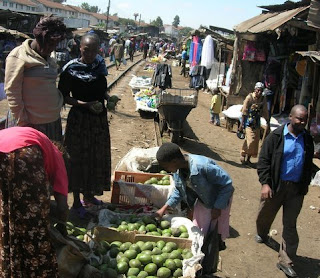
P.S. #3: Finally, here are two other photos of typical Ethiopian street scenes – I especially fell in love with the Ethiopian donkeys that are much smaller than the ones we have in Namibia (and much harder working, too).


Sunday, September 14, 2008

218: Namibia’s Matterhorn

I was recently asked to name my favorite place to relax and clear my head. In the old days before we moved to Africa, I would have answered immediately, “West Virginia.” But now, there are so many places to choose from. Eventually, I selected just one and it is Spitzkoppe, the Matterhorn of Namibia.


I’ll start by telling you a little about the geology and feel of the place and then you can understand more easily why we like it so much. Bernd and I went camping there this weekend (with the dogs) so we also have some recent photos to share.


The landmass of Southern Africa is very old and particularly rich in mineral resources. About 300 million years ago the region that is today known as Namibia was much closer to the South Pole and was covered by huge glaciers. Tectonic movement of plates within the earth’s crust caused it to move further away from Pole about 250 million years ago and then the ice melted, leaving behind glacial debris in valleys and depressions. The climate continued to change from cold and wet to hot and dry, and eventually a desert spread over large parts of the area known as Gondwanaland. Although the greater part of Namibia became covered by sand, outflows of lava emerged when Gondwanaland broke apart. Over time, heavy wind and water erosion sculpted enormous granite domes, twisted towers, and fissured outcrops all over the area, most dramatically along the rocks of Spitzkoppe (1728 meters or 5857 feet high).


Getting to Spitzkoppe requires a good car and a lot of patience, but it’s worth it every time. For miles you feel like you are in the middle of nowhere, until a huge rocky mountain range appears suddenly before your eyes. Almost tree-less, it looks like the entire mountain has been carved from one giant rock. It looks stark, forbidding, and inviting at the same time. A hotel is planned for the area, but right now the only way to stay overnight is to camp. The cost for camping is combined with an entrance fee that you must pay to the local community that manages the site as part of their communal lands. This concept of locally-run tourism aims to bring people into harmony with nature, by creating an incentive for the local population – otherwise very poor and largely unemployed – to make a small profit while preserving the land from overgrazing and hunting.


Our family comes here annually (previously with our children and now by ourselves or with friends). The equivalent of US$12 buys you the privilege of a clean campsite far away from anybody else, great hiking and one of the best views on earth. The harsh environment contains a unique biodiversity, so you must always be on the lookout for small mammals, birds, lizards and snakes – but you’re allowed to take your dogs with you, so for us this makes for a special treat.


The trick when finding a good campsite at Spitzkoppe is to locate one with shade. We’ve camped at about a dozen places around the area by now, and have several favorites. But ever since the Hollywood filming of 10,000BC at Spitzkoppe about a year ago, when the filming crew introduced several herds of zebra and springbok into the area (and consequently fenced off the mountains’ central valley), some of the campsites have been restricted. So this weekend we had to find a new site and eventually did, though the angle of the rock over Bernd’s head made us think that it could fall over any minute.


We arrived in the mid-day heat, so after unpacking we made ourselves comfortable with a stash of Stuart Kaminsky detective novels that I found in a second-hand bookstore in South Africa. (These make for great reads, intertwined juicy tidbits about the ironic contradictions of life in cold-war Russia.) When it cooled down around 4pm we hiked up the backside of Spitzkoppe, our 12 year old shepherd trailing somewhat behind due to his weak hips. We made it about a third of the way to the top (anything further would have required ropes and a climbing guide), and the view was breathtaking. Looking down, our car looks like a tiny speck of white dust.


Although it almost never rains at Spitzkoppe, we found ourselves greeted around sundown by a cold wind and a wave of fog that rolled in from the coast, 100 kilometers (61 miles) away. Whereas we were practically roasting at mid-day, by nightfall we had donned every article of clothing we brought with us – and still we were freezing. Yet, this coastal moisture is what keeps the Namibian desert alive, though it is rare to be seen so far inland. Desert plants and animals survive by absorbing the cloud-like droplets that land on rocks and waxy leaves, coveting every last molecule as the precious life-source that it is.


We crawled early into our tent, but around midnight nature called and I awoke to find a clear sky and full moon. Night-time under a full-moon is my favorite time at Spitzkoppe, so the dogs and I took a stroll in the moonlight, marveling at the mysterious rock-silhouettes, the height of skyscrapers, which surrounded the narrow dirt road. Bernd got up a few hours later for the same reason, but unfortunately for him the fog had returned.


Allow a short digression: Like many small countries, Namibia makes gorgeous postage stamps and sells them to collectors world-wide as a much-coveted source of foreign income. Elsita started our Namibian collection, and Bernd has continued it: we now have every stamp and every first-day cover that this country has ever issued. (That sounds bigger than it sounds but remember, Namibia is only 18 years old.) At any rate, to mark the Millennium, Namibia issued a dual-set -- sunset and sunrise over the Spitzkoppe. What was a great choice!! Usually we are able to see both of these when we camp, but this morning, all we had left was a cool haze. We took a second hike and returned for a late breakfast. Then we had to leave in order to get home in time to cook for fifteen: tonight is our monthly gathering for the Saving Remnant students. We have a guest speaker – a refugee from Rwanda’s 1994 genocide – who will speak about how to keep hope alive in the face of unspeakable terrors.


Other updates: Many of you have asked about Sergio’s new mailing address. Although we know he is getting trained for the Transport Corps someplace in Missouri, we have no address for him at the moment. Nor does he seem to have frequent access to e-mail. Elsita spent a wonderful holiday in Copan, Honduras (see http://moremotion.blogspot.com) and plans to extend her time in Central America by an additional 4-6 months (through May 2009) in order to get in another growing season for the native corn on which she is experimenting. Bernd and I doing well -- juggling our work, my travel and a busy home-life. (We have also started gathering our old diaries onto a blog: check out http://namibiadiaries.blogspot.com. All of our friends and acquaintances in Africa feel totally convinced that Obama will win (I even saw Obama buttons and bumper stickers in Cape Town); we only hope that they are right.


Work-wise, Bernd is teaching four courses at the Polytechnic and has developed quite a following of students who specifically seek out his classes. I recently co-authored a small book with two Namibian memes (traditional women from the north) that teaches orphans living without adults what they need to know about caring for their property, saving and spending money, accessing local services, and parenting younger siblings. It’s a dreadful sign-of-our-times that our assistance to “child-headed households” has come down to a manual (even one that will be translated into the local languages). But soon the memes will begin leading workshops with the young people on these issues, and hopefully they can be linked – at a minimum – to caring neighbors and volunteers for additional support.


This week, too, Catholic AIDS Action (www.caa.org.na) celebrates its tenth anniversary. Who could have imagined a decade ago, when Sr. Dr. Raphaela Händler and I teamed up together, that this organization would become Namibia’s largest non-governmental provider of HIV-related services? But as an indication of just how distorted local thinking has become as a consequence of our donor-driven focus on HIV, a research study was recently launched in Namibia’s far north-eastern region after it was discovered that some local women in their fifties thought they had HIV, when in reality their complaints (heat-flashes, etc) were all menopause-related. HIV was the only disease they were being educated about, so naturally that’s what they thought their symptoms revealed!


Obviously, there is still a lot of work to be done. We wish you well, Lucy and Bernd


Sunday, August 17, 2008

217: Namibia’s New Diamonds

Uranium takes over: Namibia currently produces 10% of the world’s uranium – more than any other country in Africa except Niger. Soon, however, Namibia’s production will grow tenfold, with the effect of positioning this country as a major player in the global energy and political playing fields.


The irony is that three years ago, Namibia’s major uranium producer – Rössing Mines – practically shut its doors due to the falling market. But that was before the prices shot up in a year’s time from $16 per kilogram of yellow-cake (uranium that is partially refined) to $140, thanks to the world’s voracious appetite for alternative energy sources, nuclear included.


Who is buying most of this stuff? China, as you might guess, followed by Japan, India, and Europe. Soon uranium will likely outstrip diamonds as this country’s biggest income-producer and will create at least 10,000 new jobs (no minor consideration in a country with a 35% unemployment rate). But it will also irrevocably change Namibia’s pristine coastal and desert landscapes.


Uranium concentrates in the Namib desert (the oldest desert in the world), between 20 and 40 miles inland from the Atlantic Ocean. Extraction requires open-pit mining, in some cases very deep (with less damage to the environment), or else broad surface-mining over land that has never before been disturbed in history. For example, the next site to be opened, about an hour’s drive from our beloved town of Swakopmund, will span 80 square miles, to say nothing of the multiple roads and support structures to be built. It will also have its own desalination plant – Africa’s first – to supply the 12 million gallons of water that it needs per day to spray down the radioactive dust and clean the uranium before it is shipped overseas.


I got excited about the desalination plant when I first heard about it, because Namibia’s coastal towns are already using more water than comes in every year through underground rivers to refill the coastal aquifers. But at a lecture we heard earlier this week, it turns out that this desalination plant will be constructed to serve the mine first, and only the “left-over water” – if there is any – will be available for people. (This, despite the fact that Swakopmund may well double in size due to these new mines.) Moreover, the desalination process will likely absorb and then spit-out so much chlorine that much of the ocean wildlife (seals, dolphins and fish) could be negatively affected.


The impact of these mines on the coast’s human residents is an even bigger unknown, especially when Namibia’s famous East-Winds churn up huge quantities of desert sand towards the ocean, layering everything with a fine carpet of dust-particles (our lungs, included). To prove our concerns, we heard that a state-of-the art private hospital will be built soon, entirely focusing on radiation issues, largely funded by the mine-workers’ health-insurance.


What do we conclude? It seems that Namibia’s government woke up too late in terms of the secondary and tertiary impacts these mines will have. Initially, they saw only the benefits of jobs and taxes and consequently, issued ten additional mining licenses to overseas investors before engaging an environmental impact study. (From what we can gather, corruption has not been a major factor, but rather the innocence of government planners who felt pressured to act quickly.) But by the time the environmental impact study will be completed in about two years’ time, much of the damage may already be done.


Namibians tend not to hold mass rallies or demonstrations against the government; they prefer quite negotiation in the style of an old-time Elders’ Council. Moreover, given the fact that the average lifespan in this country has already dropped from 61 (when we arrived 11 years ago) to 42 (mostly due to HIV & AIDS), long-term public health concerns take a backseat to poverty alleviation and other, more immediate issues. Realistically, you can’t blame the Namibian government for grabbing the opportunity for massive foreign investment and jobs; yet one can’t help but wish that the planning had been better or, more to the point, that there had been any planning at all.


Diamonds in the Rough: One immediate benefit is that two of the orphaned students we help sponsor at the University of Namibia will benefit enormously. Both are studying geology and the older one has already got three job-offers by the mines, with a brighter future than he could have ever imagined.


Both students are part of the Saving Remnant Program, which is an initiative I started in 2001 as National Coordinator of Catholic AIDS Action (www.caa.org.na). The concept is Biblical and draws from an analogy with a large piece of patterned cloth. The idea is that, if you can’t save an entire society then at least you must save a large enough remnant from which the pattern – that is, the structures, culture and leadership -- of the society can be rebuilt, even better and stronger, in the future.


At Catholic AIDS Action, we first provided secondary school scholarships for the best-and-brightest students we could identify among the 18,000 orphans and vulnerable children that we supported every year. The cost per child averages US$350, and often includes hostel-living (for children in rural areas who can’t commute to high school), in addition to the requisite books, school fees, uniform, and exam fees that the government doesn’t pay. But soon a new challenge arose: what to do with those Saving Remnant high school graduates who beat the odds and meet the entrance requirements for the University of Namibia or the Polytechnic? Now the cost shoots up to between US$1800 and US$5000 per year, depending on the course of study and whether the student can get a government loan (which requires their putting up collateral -- something that, by definition, most of our students can’t do).


So by hook and by crook the Saving Remnant extended its reach to 10 tertiary-level students, for whom Bernd and I serve as volunteer “Uncle and Auntie.” To that end, we personally assist some of the students financially, while the others benefit from the generous donation of friends and three local businesses. More to the point, these students have become part of our family. We learned the hard way through a first-year student who failed that most need a lot of personal guidance and emotional support to successfully pass their courses. So, four years ago we started inviting these students to a monthly dinner at our home; then we added special study-sessions, assistance with computer-access, and periodic support in-between. We encourage peer-mentoring: student to student. When Sergio moved out of the house almost two years ago, we invited one of the students to move in.


This student is Lucas Mahoni, who is now a third year Mechanical Engineering student at the Polytechnic of Namibia, where Bernd also works. Lucas hails from Namibia’s rural north-eastern region. His father died when he was six and his mother when he was nine; then he was forced out of school for one year by an uncle who wanted him to become a goat-herder. When he insisted on returning to school, an aunt let him stay with her but without any financial support. So, while still in primary school, Lucas attended school in the morning and begged for food and school fees in the afternoon at a local petrol station (where he also washed cars and helped the gas-attendants). Finally, his maternal grandmother in another province heard about his plight and invited him to stay with her, but she lived 60 kilometers from the closest school that Lucas could attend. That meant that room-and-board also had to be paid-for. That’s when Lucas heard about Catholic AIDS Action’s Saving Remnant Program, and he graduated top-of-his class.

Lucas believes that God has a special purpose for his life. How else can he explain his difficult childhood and terrible stutter (which is the worst we have ever heard – despite a year of speech therapy that we arranged in Windhoek)? When Lucas’ grandmother died last year he felt he had no one left anymore, but slowly he has drawn closer to us – as we have to him. Now he has a girlfriend (a lovely young woman), and some weeks ago he made the decision to start talking up in class no matter how much the other students laughed at his speech impediment. In telling us this, he repeated the phrase we often use with him, that what he says is worth the extra time it takes to say it. He is also feeling positive about his academics: By contrast to the majority of the students who failed or dropped out during their first two years of the Engineering program, he is a survivor.


Lucas gives us great inspiration. So does Helvi, our latest addition, who studies Economics and spends every vacation in the north helping her grandmother farm their meager fields. Or Mirjam, who grew up with two cousins in what became a child-headed household when Mirjam turned 17. Amazingly, all three youngsters made it to University: Mirjam is getting top-honors as an accounting student and will graduate later this year (also with several job-offers in hand); her cousin Simon is studying social work, and the youngest of the three – Jason – got into Stellenbosch University in South Africa to study medicine (this being the Africa’s top medical school!). But where does the money come from for all that? In Jason’s case, a physician-couple we know from Baltimore are single-handedly paying for all his expenses, with the single condition that Jason stays in Africa and doesn’t join the brain-drain to the West. (No worries: Jason loves Namibia tremendously.) And then there is Kenneth, who became vice president of Namibia’s Young Accountants’ Society, and Lydia who graduated last year in Communications and gets married in December (we’ll be part of the wedding, as it turns out), plus several others. We’re so proud of these youngsters, and so full of admiration for what they have accomplished already, despite incredible challenges. These are Namibia’s true diamonds of the future, more precious than any mineral or any stone will ever be.


PS #1: Unfortunately, Keitometsi Abu Basuto, our “second daughter,” is moving back to Zimbabwe next week. Her visa runs out and she doesn’t want to risk staying in Namibia illegally. We’ll miss her and wish her all the best, and hope for her return one day.

PS #2: On a brighter note, we reveling in the visit from our dear friends Karen and Aron Primack, with whom we often stay when visiting the Washington area. Aron says that Namibia is so beautiful that you can’t even absorb it all. We’re delighted they are enjoying it so much and hope they will encourage others to visit, as well. (Here we are on a boat with Spotty the seal.)


Monday, July 28, 2008

216: Lucy’s Annual Elephant Fix

Every year I feel a desperate craving to head north and look for elephants. Usually that means going to Etosha National Park, Namibia’s largest (the size of Belgium), for the weekend. It is best to go between June and October after the rains have ended but before the summer heat sets in, as this means you can sit comfortably in your car by the watering holes where the animals gather to drink. It’s still hit or miss in terms of what you will see, but chances are that in two days, you’ll see a lot.

Bernd wanted to see giraffe, hyenas, and owls (his favorite bird), and Keitometsi, our Zimbabwean “second daughter” who has been living with us for the past few months, was hankering for lions and vultures. The latter comes from last year when Keito and Elsita lived together to do vulture-research at Namibia’s Rare and Endangered Species Trust (which is how Keito came to join the family). We decided to camp just outside the park to save money, and took off from work on Friday and Monday in order to make the most of the weekend. Bernd was in charge of the camping gear, I took responsibility for the food, and we told Keito that she was responsible for everything else.


When we left Windhoek on Friday morning, we were already feeling great. Sergio had flown into Namibia earlier in the week for a three day visit – he is now a full-fledged Marine, private first-class -- and looks great. As much as military life scares us, Boot Camp made Sergio into a man, brimming with knowledge and self-confidence. Every minute with him was precious, and we are swelling with parental pride. Sergio has two more bouts of training before he gets shipped overseas, so we are determined not to start worrying yet. We shall keep you posted as soon as we get his new address, as well as other information. (Above is a photo of Sergio - taken by Elsita, who was able to attend his graduation from Boot Camp.)

Driving from Windhoek to Etosha takes 5 to 6 hours, depending on which entrance you use. We arrived mid-afternoon, still in time for our first self-drive visit into the park. Our highlights were about 30 giraffe, seven species of antelope, lots of zebra and wildebeest, and a field of 200 banded mongoose -- but no elephants. The next morning it was the same and Keito started getting nervous. We teased her that, being responsible for everything else meant that she had to produce elephants or else we wouldn’t guarantee dinner. Finally, by mid-afternoon two lone bulls came forward and Keito breathed a sigh of relief, knowing that she wouldn’t have to starve. We counted two more elephant bulls by the late afternoon but had stopped counting giraffe by then – we had surpassed sixty. Then came some bonus animals: two hyenas, a close encounter with a lilac-breasted roller, and a white-headed vulture that is quite rare in Namibia and never before seen by Keito. Unlike most vultures, this one is beautiful, with a slim red and blue bill and pink face and legs.


Shortly after our outdoor dinner Keito went to sleep, but Bernd and I checked out the lamp-lit water-hole at the far side of our camp. My eyes caught a large fluttering in a distant tree. I hoped it would be an owl, and sure enough – suddenly it lifted off in our direction and landed just to the right of the watering hole. Eleven species of owls occur in Namibia, and this was the biggest (almost two feet in height): the giant eagle owl, B. Lateus, a large gray bird with distinctive pink eyelids and dark brown eyes and ear tufts, not always raised. The male voice consists of a series of grunts while the females and young make a long, drawn out whistle that sometimes can be heard all night. Their favorite prey is hedgehog, which is eaten after peeling off and discarding the skin. Much as we hoped to witness the excitement of an owl-kill, we thought that something a little less gruesome would be preferable. But anyway, we sat and waited.

In the wildlife films you see on TV, the cameramen make you think that high-drama occurs every few minutes or so. In real life, we can attest that this is not so. After an hour, I became convinced we were watching a still life. Nothing moved – not the owl, not us, and not anything else. Then suddenly, in complete silence, the owl swooped down to the grass and started picking at something by its feet. Had it caught a mouse? A giant frog? We couldn’t tell, but in 30 seconds the meal was clearly over, and the still life returned.
We went to bed satisfied, only to be woken at 3 a.m. by a cacophony of deep-throated roars. If the owners of the campsite hadn’t told us that a protective fence surrounded us, I would have been convinced that the lions’ roars were just outside our tent. Sleep became illusive, so we just lay in our sleeping bags and enjoyed the concert. By sunrise the quiet returned, and we set off once again for the watering holes in Etosha Park. What would we find on this day?


Last week I wrote you about the rock-dassies in our backyard. Although these are the elephants’ closest living relatives, it is a distant relationship – as the evolution of both went separate ways about 6 million years ago. What ties the two animals together is that both animals do not ruminate (chew the curd). The organ they use to digest the huge amount of plant material they eat is not a true stomach, but part of the large intestine, namely the caecum (in humans, the appendix). One consequence of this system is that they are very inefficient eaters and must feed up to 16 hours a day to extract sufficient nutrients. This places a tremendous burden or their teeth, but in the case of elephants each molar-tooth is only expected to last a few years. As the teeth wear out and flake off, they are replaced from behind by a next set. The new teeth are always larger, so tooth size keeps pace with the expanding jaw. (I don’t know if this works the same way with dassies, but they don’t live as long, either.)

The evolution of elephants goes back more than 70 million years ago. It belongs to the order Proboscidea, of which just one family – the Elephantidae – is extant today. Etosha’s elephants are among the largest in Africa, the tallest measuring up to 4 meters (12 and a half feet) at the shoulder. Adult bulls have a mass of between 5500 and 6000 kg (12,100 – 13,200 pounds), while the cows measure about two-thirds that weight. Their tusks, on the other hand, are smaller than those of elephants elsewhere in Africa. This is probably due to breakages resulting from mineral deficiencies in their diet and genetic defects. The fact that Etosha’s elephants have smaller tusks is a distinct advantage, insofar as they are less likely to fall prey to ivory poachers.

Where a supply of clean, sweet water is normally an essential habitat requirement for elephants, in Etosha they have adapted to the water with its high salt content, the salinity of which sometimes exceeds that of seawater. Elephants are both browsers and grazers. During the rainy season, Etosha’s elephants will vacate the park and head into other areas of the country, causing much damage to fences and crops. Namibia’s wildlife service has developed a policy of compensating local farmers to the north and east of the park for damage these roaming pachyderms leave in their wake, which is how the government keeps the local farmers from killing these national treasures. By contrast, the elephants that head west for the desert during the rainy season earn back this money for the government in tourist dollars, as Namibia is the only place in the world where you can see elephants amidst sand dunes.*

So, off we went: The first water-hole we visited was dead as a doornail.
The second water-hole was the same, save for a Marshal Eagle and an assortment of wildebeest, springbok and black-faced impala in the distance. The third water-hole, once again, was empty. Just as we started back to the campsite, however, a beautiful oryx crossed our path, and then we hit a zebra crossing – literally: forty of these animals walking single file across the road, with babies in between, heading for the watering hole behind us. I looked back to watch them go. Omigod: A large gray hump was moving, as well. And then another and another: Elephants! Lots of them!

As if by magic, now the water-hole suddenly boasted about a hundred animals. They came from all sides: a herd of thirty female elephants with babies, about forty antelope of various kinds and finally, all the zebra whose fortuitous encounter caused us to hang a U-turn to see this teeming display of African wildlife. We stayed about an hour and a half, soaking it all in. Later in the day we came across another twenty elephants bathing in a deep pool of water and having a glorious time.

Our lives have been blessed in so many ways. Thirty years ago, this week, Bernd and I met each other while on a camping trip to Iceland. This weekend felt like a most fitting celebration.


* Reference: Notes on Nature by Amy SchoemanMacmillan (Windhoek Namibia, Gamsberg Macmillan, 2002)

Tuesday, July 15, 2008

215: Survival in African Context


Here are three tales of survival – techno-logical, human and animal. The first is frustrating, the second is complex, and the third one will make you smile.

I. Survival in the age of Technology: Please forgive my lack of communication over the last few weeks. In late June my laptop crashed in Kenya, along with all the data I needed for that trip. Awful as that was, I wasn’t too worried about losing all my other data because I had dutifully backed up most of my hard-drive on the so-called “Master Server” at work. Unfortunately, just as I returned to Namibia my very-pregnant colleague placed the first draft of a manual we had been writing onto this same “Master Server” --- and the day afterwards a huge power-outage caused that computer system to crash, as well.

Now what are the odds of THAT happening? (As luck would have it, Bernd was out-of-town that week at a Great Teachers’ workshop.) The overall stress was so great that my colleague went into premature labor, though fortunately her doctors could stabilize her condition. (She’s now on total bed-rest.) Needless to say, we’ve been in “recovery mode” ever since -- but slowly things are falling back into place, first draft included.


II. Survival over adversity in Kenya: Last month (for the Stephen Lewis Foundation) I discovered a most amazing project in Kenya’s rural southwest-province. It is an all-volunteer women’s group that began in 1990 when several grannies realized that they had lost opportunities in their lifetime because they never learned to read – and they decided to ensure that their daughters and granddaughters would not have to suffer a similar fate. As a result, they banded together to raise money to send their girl-children to school. To begin, they established a “food bank,” whereby they pool their meager earnings to buy bags of grain immediately after the harvest when they are cheap – and then store them in the “bank” (a secure, dry building) for sale later in the year when the prices go up. They share a portion of the food with the poorest households in the community, and over the years they have further invested their profits to buy a hand-operated sunflower press (to produce oil), bee-hives (to produce honey), a chip-maker (to cut potatoes into strips for French-Fries), and a nut-grinder (to make and sell peanut butter). Now, eighteen years later, this community has educated so many girls that whenever the Ministry of Education seeks to recruit new teachers, they always come to this village first. Additional spin-offs over the years have included two local “self-help savings clubs,” a home-based-care project, and an after-school club for orphans and other vulnerable children. These women absolutely blew me away!

During this same trip to Kenya, I also spent time in Kibera, Nairobi’s largest and most notorious slum. Here nearly 2 million people live crammed together in tiny tin shacks amidst open sewage, rotting carcasses and overpowering filth. The first project I visited trains former Commercial Sex Workers in Home-Based Care and HIV-prevention, and provides micro-enterprise loans for HIV-positive women who want to run (or improve) their own small-scale business. I’m amazed by the degree to which this project instills hope, despite the desperate surroundings.


The first time I assessed this project was with Elsita in 2004 and we met a woman named Joyce – bedridden, thin, and seemingly with just a few days to live. Even back then, however, Joyce whispered to us that she still had dreams: she wanted to open a small shop and sell exotic dress-material, and possibly go back to school for a course in fashion design. Soon after we left Joyce, I heard that she began taking ARVs (the anti-retroviral medications to treat HIV/AIDS), and when I visited the project again in 2006 I saw that Joyce had improved greatly. She was still thin and weak, to be sure, but able to care for herself and participate in various community activities. Now two more years have passed, and once again I saw Joyce. We hugged each other warmly. Wow! Joyce looks great, and she told me about the training she recently received in preparation for a small loan she would get later that week, with which to buy cloth to sell. “It isn’t much,” she said, “but it is a start.” The rules of the program are clear: One loan per person. Joyce would have to pay this loan back over six months, and then she could get a second, larger loan to grow her business even more.

Ten days later, I returned to Kibera once more to visit another organization’s project. They had also started to give out micro-enterprise loans for economic empowerment and wanted me to meet one of their clients. So once again, we walk through the narrow, sewage-filled alleyways of Kibera, past market stalls and one-room hovels. Eventually we entered one small passageway, and then another, and finally we stepped down a few steps. Upon entering the one room shack where the client lived, my jaw dropped. Here was Joyce, once again – now a client from this second project -- obviously breaking the rules and benefiting from at least two different organizations simultaneously.

Out of nearly two million people in Kibera, what are the chances that a visitor like me from the outside would have discovered her deception? I asked Joyce some questions and eventually she explained: “One loan is not enough,” she said, “not for the dreams I have waited so long to fulfil.”

At first I felt angry: with all the needy people in this community, why should one person benefit twice and others not at all? And then I thought to myself: Who am I to judge Joyce under such circumstances? Mightn’t I be doing the same? In this dog-eat-dog world you have to put yourself in the other person’s shoes. Perhaps this is how survival works: Joyce is certainly not the first to invent this kind of manipulation, nor will she be the last…

III. Survival in our Back Yard:
Southern Africa boasts three species of dassies or hyraxes: two live in rocky areas (such as the back yard of our house) and one in trees. Dassies are sometimes called rock rabbits because of their size, but they are not even distantly related to rabbits and can easily be distinguished from them by their short, rounded ears. In fact, their closest relatives are the elephants (!!!), but obviously this relationship is very distant. A territorial male controls a colony of 3-17 females and their young, but males without territories are solitary. Gestation lasts 230 days, which is very long for an animal this size. Dassies eat a wide variety of vegetation, even consuming plants that are poisonous to domestic stock.


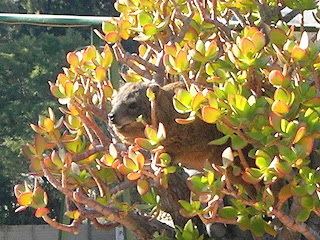
Until this year, we mostly had just a solitary male living in our back yard, but now we have acquired a large harem. Their piped squeaks can be heard all day long. This drives our dogs crazy, but dassies can hide where dogs can’t reach, so they have gradually learned to co-exist. On the other hand, the plants on our veranda have suffered immensely. In the dry season (like now) the little dassies gravitate to anything green and have discovered the treasure-trove of our carefully tended succulents. One by one, our plants are being stripped of their leaves – but these animals are so cute, we let them have their fill. The photos below show how “survival of the fittest” truly works. And if we can’t have elephants in our back yard, their long-lost cousins will have to do!

Kind regards, Lucy

P.S. Speaking of survival, we’re proud to tell you that this Friday (July 18) Sergio graduates Boot Camp to become a full-fledged Marine! He wrote that the cards and
letters he received from well-wishers really helped him get through the rough-spots. (Thanks so much!) His training will continue over the next few months. We still have a little breathing time before he gets shipped overseas…

Wednesday, June 11, 2008

214: A Perfect Visit Where You Least Expect It


My wish for all parents is that they can share five days with their son or daughter with the same bliss, pride, and sheer fun as I recently had with Elsita in El Salvador*. (My only sorrow is that Bernd couldn’t be with us.)

That said, I also learned a lot: Before coming to this country (following a short trip in the USA for work and pleasure), my consciousness about El Salvador began and ended with their civil war (1980 – 1992). Thus, I was aware of the terrible deforestation, declining crop-cycles, grinding rural poverty, and devastating economic practices that are ruining what few natural resources this country has. But this was my chance to get beyond that – and so I did, beginning with Elsita’s wonderful NGO co-workers and seeing her interact gracefully with poor women-farmers in the field. [I also saw the first-draft of two practical manuals Elsita has written in Spanish on native corn-seed-regeneration and on composting, which she will soon test with the farmers -- each of which forms a vital part of her organization’s dedication to sustainable agriculture. Oh, what motherly joy!]


Because Elsita’s office is based in San Salvador, the capital, this is where she lives – and where I also started my visit. San Salvador turns out to have many pleasant streets and the best public bus service I have ever encountered. (Buses come frequently and cost 25 cents or less.) San Salvador also houses a small Jewish community that is four times the size of Windhoek’s and holds an egalitarian Sabbath service that truly feels welcoming. Elsita and I also visited the national museums of art and anthropology (that are excellent), and sampled the local cuisine in various restaurants with Elista’s housemates and colleagues. (This was in addition to Elsita’s own cooking where I can now testify that she does make great tortillas and other typical dishes.)

The trip’s highlight, however, occurred over the weekend: Elsita and I left early on Saturday morning for Santa Ana, the country's second largest city about a ninety-minute bus ride away. Some weeks ago Elsita had booked us a night at an indigenous back-packer's lodge that came straight out of the 19th century (except that it had electricity and a few other accoutrements). From the outside it looks like a boarded-up warehouse but the moment you open the door you step into a paradise of comfortable colonial furniture, artsy oil paintings, a beautiful garden, and a large selection of old photography books on local culture and crafts. Our host greeted us with fresh coffee in the cozy guest-kitchen, and then showed us to our room, with twin beds and a private bath. Best of all, however, the shower offered hot water –something that Elsita hadn’t experienced for the previous four months and called positively “orgasmic.” But if you feared we broke the bank for all this luxury, don't worry: the room cost us US$9 apiece, everything included. Dinner that night added only another US$4, per person.

Santa Ana's downtown area was about 30 minutes away on foot. I was struck that virtually all the residential buildings were just one story high and stood buttressed against one another as a protection against possible earthquake damage. Only the town’s main square boasted larger structures -- framed on four sides by the cathedral, municipal government building, city museum, and an old theater (now a school for the performing arts). Just to one side of the Cathedral an old man sold bags of pigeon-feed, and we watched a little girl dole out the grains one-by-one, as if the world’s future depended on her making sure that every pigeon got its fare share. (Too bad that Trafalgar Square now prohibits this custom – I think it truly constitutes one of the world’s great childhood pleasures.)

Soon we hopped another bus to El Salvador’s answer to Crater Lake – in this case a smaller but equally beautiful body of clear blue water known as Coatepeque that is surrounded by high volcanic mountains. The bus took an hour and a half and cost 48 cents apiece. Because there is only very limited public access at the lake we approached a hostel that allowed for day accommodation -- here we had the place to ourselves and lounged in hammocks, bought lunch, swam, played with some local kids, and paid a total of US$5 apiece of us for the privilege.


That evening, we met some interesting graduate students from Harvard University who were in the country to study micro-financing enterprises among local women-cooperatives. This forced us to once again confront some of El Salvador’s harsher facts of life. Sadly, much of the students’ project has been hampered by the presence of gangs that extract bribes from the women, ostensibly in exchange for protection - but that basically means protection from the very same gangs who offer their alleged "assistance." Our conversation reminded me of insights that Elsita's supervisor had offered while we were out in the field a few days before -- for example, that the government deliberately underestimates El Salvador's population in order to make the per-capita income seem higher than it is (thus, encouraging outside investment), while at the same time keeping the labor-pool large and very cheap. Currently, the country’s main source of income comes from remittances by Salvadorans living abroad (even now, about 500 Salvadorans leave the country daily). These remittances are free-money, as it were, because no one inside the country works for it. This leads to high consumer demand for cheap products and it keeps most people from protesting against the government. But it is a pernicious, arbitrary system where one neighbor benefits and another -- equally needy or even more so -- barely survives. To illustrate this viscous situation, the Harvard students explained that in El Salvador's poorest areas a household that receives remittances often averages US$6 per adult per day, whereas a family in the same area without this external income has to survive, on average, on just one dollar per adult per day. (Keep in mind that El Salvador continues to have one of the highest birthrates in the world, so that dollar gets spread very thin.)

By Sunday morning, however, Elsita and I left these politics behind and caught yet another bus for the Cerro Verde National Park. These public-bus journeys continued to amaze me: almost all are brightly colored American school buses that live out their retirement by working harder than they ever had to before. On some of the buses you get piped-in music or third-rate American films, but on the local-yokels all the entertainment comes from constant stream of bargain-sellers who alight at one stop and step off at the next, and meanwhile try to sell you sweets, fruits, drinks, french-fried potatoes, biscuits, herbal potions, home-made medicines, creams, condiments, and a wide variety of cheap plastic toys. Sometimes you also get a singer or two, or some evangelist, or else a blind clown, deaf-child, or some other unfortunate who aims to collect your extra change.

On this particular ride, however, we were left blissfully at-peace during the last twenty minutes or so, as the diesel engine choked its way up a one-lane road through a dense rainforest. Finally we reached the National Park entrance, paid our one-dollar entrance fee, and walked uphill for a couple hundred meters until the first viewpoint. "Omigod!," I could scarcely contain my awe. Before us stood a recently erupted giant volcano with its brown-black lava like chocolate-nut icing on a huge bitten-off cone. We were about eye-height to the top -- standing, as we were on an even larger volcano (but one that has been dormant for several hundred years). The view extended even more broadly, however -- to our right was a row of mountains and straight ahead a steep escarpment that ended some fifty miles away at the Pacific Ocean. The view was gorgeous, simply breathtaking, and in itself, worth the entire trip.

We gaped for about ten minutes or so, and then walked aimlessly until we met a young woman who offered to take us on a guided walk (guides are required in the Park’s cloud forest). This was also wonderful. Although we heard several owls we didn't see them; yet we took in some splendid views with shimmering butterflies and large iridescent blue-black birds. For a while we watched the clouds roll in and out of the mountains. Most of all, however, I feasted on the intense shades of green all around me, knowing that in a few days I would be returning to the Namibian desert and this would have to sustain me for a long time.

We hitched a lucky-ride back to the main road and took a series of buses back to Elsita’s house, and all the while I kept thinking: who would believe me that El Salvador could be such a beautiful and pleasant country to visit? Of course, I'm biased from having the most conversant and wonderful tour-leader imaginable. Truly, I couldn’t have asked for anything more.


P.S. Sergio writes that he is doing very well, and expects to graduate Boot Camp on July 18. Thanks for your support!

*Elsita is in El Salvador for ten months as part of a year-long fellowship with the American Jewish World Service. See Elsita’s web page
More Motion and our Namibian Diary #213 for more information.

Sunday, May 18, 2008

213: Turning into Corn

Some of you have been asking for family updates. Here they are:

Sergio:
Sergio joined the U.S. Marines as a new recruit four weeks ago. Although this has been a near-lifelong dream for him, it's been tough going. Not surprisingly, he writes that the military-issue boots hurt his feet (by contrast, he only wore sneakers and sandals in Africa); that the heat and humidity have become a daily torture (quite a change from the dry weather back home, especially given the rigorous work-outs every day), and above all, his long and unpronoucable name is killing him... (Poor guy! Unlike Elsita who took up our offer a few years ago to legally change her name, Sergio chose to retain the hyphenated double-surname we mistakenly inflicted on our children. You can imagine - Much as we loved the egalitarian ideology of our approach at the time, now we feel very guilty for the hardship we caused!)

In general, Sergio reports having a lot of second-thoughts about the path he has chosen, but at the same time he is determined to make it through the process. Bravo to him! This would be no mean feat. Within the first three weeks of Boot Camp, his group of recruits already dropped from over 80 to 72 -- with three-quarters of the training still in front of them.
Elsita:
Meanwhile, what we hear from Elsita is absolute delightful. You can read her whole blog at
Elsita's Blog, but we have excerpted a few paragraphs below (with her permission):

Corn, or “Maíz”, as it is called in Spanish, is the staple food of El Salvador... In fact, during the course of my time here in Central America, the presence of corn has been almost overwhelming in my day to day life (in a good way). As I may have mentioned before, my work placement is with a Salvadoran non-governmental organization in the field of sustainable agriculture and food security. From what I can tell, my work here basically involves becoming a corn farmer.

At the moment, in the rural communities with which my organization works, farmers buy hybrid corn seed to plant every year. Hybrid corn is nice because it is bred to give high yields, resistance to diseases and other desirable characteristics. Due to a biological phenomenon known as hybrid vigour, the crossing of two inbred corn lines results in the first hybrid generation showing the best of the parents´ most desirable characteristics. Breeders manipulate the pollination process of inbred lines in order to achieve this. However, in the second generation, mediocre characteristics of the grandparent corn resurface, so yield and disease resistance decrease. What this means is that seeds collected and replanted by farmers for the next year do not become particularly productive plants, so the farmers inevitably become dependent on purchasing the seed every agricultural cycle. In addition to this, they also must purchase fertilizers, insecticides and herbicides that go along with the hybrid seed, and as you might imagine, the costs add up quickly. Why do farmers buy hybrid seed? Apparently, seed companies operate intense propaganda schemes that lead to the notion that hybrid corn is intrinsically better than open pollinated varieties. Similarly, transgenic (genetically modified) corn is also on the rise. It is the most expensive seed available, and also thought to be better than other varieties. Transgenic corn also requires chemical inputs (fertilizers etc), and it is genetically engineered to not produce viable seed for replanting, so again, farmers depend on buying the seed every year.

The overarching goal of my job is to find sustainable alternatives to all of these practices. My main project is to figure out ways to productively breed Creole Corn (a non-hybrid variety), or to put it more specifically, to figure out how to select the best, strongest, healthiest seed for replanting next year. My first assignment at work was the reading of a 400 pg manual in Spanish entitled ``El Maíz en los Tropicos: Mejoramiento y Produccion´´ (Corn in the Tropics: Improvement and Production). Slow reading but fun stuff. Since then, I have done lots of online research, and put together a short manual with descriptions of possible techniques. In the upcoming months, I will be going into the field and testing out the theory. Hopefully the experiments will then be the basis for development of solid breeding methods that can be used by future farmers as an alternative to buying expensive hybrid seed and related inputs. My biggest worry aside from actually carrying out this project, is making sure that it can be sustainable after I leave, given that I´m here for only one harvest. Thus, I want to work very closely with the farmers who know a lot more about planting corn than I do, incorporate their normal cultivation methods in the Creole Corn experiments, and through that process hopefully generate a lot of interest in the results.

And in case you thought I would gloss over the most well-known symbol of Latin American cuisine you will not be disappointed as I further describe my food adventures. I refer of course to the tortilla – the staple, the bread, the unfaltering companion to all meals, the beginning and the end, the little yellow disc of warm toasted goodness. Between the tortillas, the pupusas, the elotes (corn on the cob), the atols (hot corn drink), the tamales (doughy corn dish) and other popular meals, I rapidly realized that not only am I turning into a corn farmer, but I am in fact, turning into corn myself.

But I digress… The tortilla! The tortilla is an unleavened circular corn-bread that is hand-flattened by women everywhere I have visited so far. Unlike the North American tortilla, it is slightly thicker and much smaller. Within my first week of cooking at home, I embarked on my very own food adventure: trial-and-error tortilla making. With disbelieving roommates in attendance, I started my first tortilla attempt by slowly adding water to “harina de maíz” - corn flour – to reach the consistency that I had admiringly observed at street stands all over. So far so good: I rolled the dough into balls, then flattened them into discs and fried them in oil. Very tasty, but wrong! In fact, there is no need for the oil frying. Locals place tortillas on “comals” - large sheets of metal, heated from below that permit tortilla-making by the dozens. Now I leave the tortilla dough on the pan at low heat, flip over a few times and then eat the tortillas hot with veggies, meat, and sauce. Practice makes perfect: My roommates have concluded that I am genetically predisposed to know how to cook tortillas.

Bernd, myself, and more:
We’re doing well. We found a beautiful camping spot last weekend and enjoyed some great vistas – also an onslaught of curious creatures known (of all things) as the Namibian Corn Cricket. Their six-legged coordination and bobbing antennae were amazing to witness, as you can see from the photo below.

Next week I'm off to New York, Washington and El Salvador for a 3-week combination of work and vacation (the latter being girly-girly and mother-daughter stuff – just fabulous!). This is Bernd's gift to me after his trip to Mongolia and Elsita's graduation last year -- but I'll miss him a lot.

Finally, I want to update you on a completely different matter: You may not believe it but our Kosher-meat rabbi from Israel is back in the country (you remember: the one who wanted to convert all the local abattoirs into producing kosher meat for export and then ran afoul of the political authorities). Now he decided to export long curlicue kudu-antelope horns to become shofarim (for blowing on Rosh HaShanah and Yom Kippur in the synagogue) – apparently, with great initial success. Fortunately, he has given up his bid to become Chief Rabbi of Namibia, so this time everyone is happy. (Except maybe for the kudu, although he only takes the horns from those who already died.)